Hi there! I know it’s been a while, but hey! College keeps us all busy, right?. Today’s topic it’s a big one: «Creativity» I’m really excited about it, I know it can be a complicated subject to describe, but I’ll try my best!. Here we go.
What do you think when you see this image?

A variety of answers I have heard, some crazier than the others but, two remain showing up, the first one is a hat which I totally see too, a weird hat, with an odd shape but still, a hat. Still, there is a little point on the right side of that hat, and that’s where the second answers come: it’s a snake, with a big tummy or it ate something huge.

This picture is a famous quote from the well-known book «the little prince» it says that the image is actually a boa constrictor who has swallowed an elephant. I completely understand if you didn’t think of it, I didn’t either. The thing here is that a lot of people criticized this image since they couldn’t see beyond the simplicity of the drawing to what it is the creativity that lives inside. The book usually is about how when we are little we have big dreams and while we continue growing up those dreams start to fade away, and some think that wth that goes our creativity and that my friends it’s not true. Our brains are divided into two: divergent thinking and convergent thinking, our imagination, along with our creativity, remain in the divergent thinking. We usually stop, and we don’t frequently use it anymore while growing up and we start thinking that we are not creative or, in this case, we cannot open our minds to think outside the box or better yet break it. We’ll get more into this topic in another blog.
The first questions that pops into our minds are am I creative? How creative am I? Can I become more creative? An then goes the doubts about whether only certain special people are creative or everyone is potentially creative in some way; and whether some activities are more creative than others. But, at the end of the day, what is creativity anyway?
According to Arthur Cropley «Creativity is not confined to fine art, literature, performing arts, music, and similar artistic domains, but also occurs in fields such as business, manufacturing, technology, medicine, administration, education, even defence. Its products include tangible objects such as artworks, books or music, as well as buildings, machines, or devices, but go beyond these to encompass ideas, processes, services, or systems of operation, production and delivery.»
As we already saw, with creativity people usually think it’s something just related to arts and specific people (most of the time the ones studying something that has to do with arts) are the only ones that are capable of it, along with children. But fellas, WE ALL ARE CREATIVE, the thing is that for some our creativity is locked up since our childhood and we haven’t had the chance to explore it again.
Sadly, in schools creativity is not an essential subject to encouraged students to take or to have more skills in it there are a lot of studies and people talking about if schools are killing creativity (Here is a link to a video with more information about the topic https://www.youtube.com/watch?v=iG9CE55wbtY), and that has a consequence later in life because creativity exists everywhere: from a great painter to the most boring job you could ever imagine.
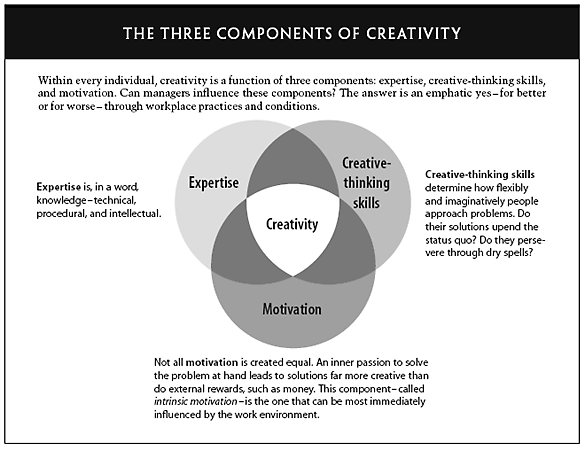
Author Teresa Amabile proposed that employee creativity may be achieved when three primary constructs are grouped together: expertise, creative-thinking skills, and motivation. «Expertise refers to everything a person knows and can do in the broad domain of his/her work. Creative-thinking skills encompass the capacity to put existing ideas together in new combinations when approaching problems and solutions. Motivation actually determines what people are willing to do and how likely they persevere through tough problems or obstacles» Take into account that this won’t necessarily only apply to the employee but to every individual.
I hope you liked this blog and if you have further questions, don’t doubt contacting me. I will leave you with a quote, and please, remember, we are all creative we just stop practising it for a little bit sometimes.
You can’t use up creativity, the more you use, the more you have.
Maya Angelou
References:
Pope, R. (2015). Creativity: Theory, History, Practice. Abingdon: Routledge.
Cropley, A. (2011). Definitions of Creativity. 10.1016/B978-0-12-375038-9.00066-2.
Amabile TM, Hennessey BA, (2010). Creativity. Annual Review of Psychology, 2010, Vol.61, p.569-598

