Hello everyone! Hope you are having a great day. Today we have more juicy material to talk about. In the first three blogs, our main topic was thinking, and while divergent and convergent thinking where mentioned, we never actually had the chance to get deep in it. In the last blog, we talked a little bit about creativity because I really wanted to have that subject explained for this topic to be more understandable. Now, it’s all about these two beautiful parts of our brains. With that said. Let’s jump right into it.
A little definition to begin with: Divergent and convergent thinking skills are the essential cognitive processes involved in solving problems (Guilford 1957). Divergent thinking seeks to understand the problem from multiple perspectives and to generate various solutions. While convergent thinking is the process of evaluating and selecting the most optimal solution based on some criteria (Basadur 1990).
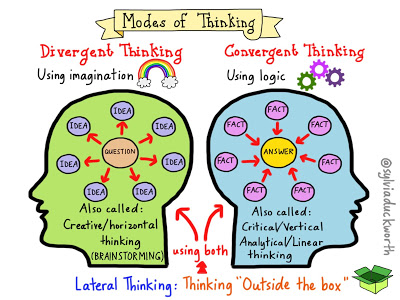
This two kind of thinkings don’t need to be right or wrong or don’t have both (which you actually can not have them). The main difference comes when you are using them and if you are doing it a the same time. As Basadur said, divergent is thinking the ideas while convergent is evaluating those ideas, meaning, both are part of a process, and what is a process? A series of steps to get to do something.
Anne Manning, a Harvard instructor for the course: «Creative Thinking: Innovative Solutions to Complex Challenges» in a video, she talks about the main difference that we just described with a peculiar exercise. She asks her students to stand up and try to reach the sky with their hands, later she tells them to bend over and try to touch their toes. Some found the first one relaxing and make them feel awake, on the other hand, the second one felt kind of depressing and restrictive. Manning explains that we usually try to use our divergent and convergent thinking at the same time, and this exercise is an analogy since you can’t reach the sky while you are bending over.

We have clarified that those parts of our brain aren’t excluding it’s crucial to understand that divergent and convergent thinking skills in the process of problem-solving in all domains can be applied to solve real-life problems.
Probably you thought that an engineer usually only uses his/hers convergent thinking. Still, now that you know that to make decisions we unconsciously use both parts, you would completely agree that it is one of the critical engineering design competencies needed to design a system, product, electronic circuit, network, etc., for a given real-life open problem. In the engineering design process, a designer has to follow a systematic problem-solving process having phases- understand the problem, design a solution and implement. By incorporating divergent and convergent thinking in each stage, the outcome can lead to a better or innovative solution.
Now, what we need to work with as Anne explained is giving time to each of the steps to occur, let the brainstorm be and later evaluate those ideas because if you try to do it at the same time, you might get a little bit disappointed if your thoughts are being destroyed while you are coming with them.
If you liked this blog, please share it with your friend and if you have any doubts don’t hessitate to ask me.
References:
Basadur, Min, Mitsuru Wakabayashi, and George B. Graen. «Individual problem-solving styles and
attitudes toward divergent thinking before and after training.» Creativity Research Journal 3.1 (1990):
22-32.
Guilford, Joy Paul. A Revised Structure of Intellect: Studies of Aptitudes of High-level Personnel.
University of Southern California, (1957)
Manning, A. Convergent vs. Divergent Thinking. Harvard Professional Development (2018). https://www.youtube.com/watch?v=xjE2RV6IQzo
Liu, Zhiqiang, and Dieter J. Schonwetter. «Teaching creativity in engineering.» International Journal of
Engineering Education 20.5(2004): 801-808.

